

Israel is a small yet diverse Middle Eastern country with a long coastline on the eastern Mediterranean Sea and a small window on the Red Sea at the Gulf of Eilat (Aqaba). Israel is bordered by Egypt and the Gaza Strip to the southwest, by Jordan and the West Bank to the east, and by Syria and Lebanon to the north. It shares borders to the Jordan River and the Dead Sea with the West Bank and Jordan. The West Bank, East Jerusalem, and the Gaza Strip have been under Israeli de-facto rule since 1967. In addition to the majority Palestinian Arab populations living in these regions, the Israeli Government has built many Israeli settlements in the West Bank and East Jerusalem as well as in the annexed Golan Heights.
Although Israel was established specifically for the Jewish people, following the Second World War, Israel is considered part of the Holy Land (together with areas of Jordan, Egypt and the Palestinian Territories). The three monotheistic religions -Judaism, Christianity, and Islam- all have historical ties to the region. Israel thus contains a vibrant modern history and culture, based in part on the diverse, immigrant origins of its inhabitants returning from the Jewish Diaspora. These aspects make Israel a fascinating destination for many travellers and pilgrims. As a result of this vast mix of culture, in addition to the official languages of Hebrew and Arabic, Russian and Yiddish are also spoken by a significant minority of Israelis. Within Israel's recognized pre-1967 borders, about 90% of Israelis identify themselves as Jewish, the remainder classify themselves as either as Arab and or Palestinian, Bedouin or Druze.
Israel is a highly urbanized and economically developed society and is therefore best divided for the traveller into its main cities and towns, followed by the regions and other sites.
Regions
Israel possesses a number of diverse regions, with landscapes varying between coast, mountain, valley and desert landscapes, with just about everything in between. Beyond the towns and cities, each region of Israel holds its own unique attractions. The metropolitan areas of Jerusalem and Tel Aviv form very much their own regions; from north to south, however, Israel's regions are as follows:
The Upper Galilee — from Dan at the base of Mount Hermon down to the Beit haKerem Valley in south, and from the North Coast across to the Sea of Galilee
The Lower Galilee — the hills immediately north of the Jezreel Valley
The Sea of Galilee (Kinneret) — diverse landscapes and settlements around the lake, many with connections to the life of Jesus
The North Coast — sometimes called "Western Galilee", extends along the Mediterranean shore from Haifa to Rosh Haniqra and the Lebanese border
The Jezreel Valley — an extensive inland valley, largely rural, extending inland from east of Haifa to the Jordan Valley
The Beth Shean Valley — the core of the north Jordan River valley
The Carmel Range — a small yet diverse region of hills just south-east of Haifa
The Sharon — broadly speaking, the coastal plain north of Tel Aviv, south of the Carmel Range
The Shephelah — the fertile, hilly hinterland between the coastal plain and the Judean highlands
The Southern Coastal Plain — location of the cities of Ashdod and Ashkelon
The Dead Sea — the lake and immediate surroundings forming the lowest point on Earth
The Negev — desert covering much of the south of Israel, including Machtesh Ramon
Geographical / natural sites
The Dead Sea — A sea of hypersalinated water and the lowest point on Earth.
Ein Avdat — canyon situated in a National Park.
Mitzpe Ramon — crater (cliff) located in the middle of the Negev desert (the largest of three similar craters found in Israel)
Ein Gedi — nature reserve, kibbutz, and botanical gardens on the shores of the Dead Sea.
Sea of Galilee itself — the home of Christ, a freshwater lake located in northern Israel. Leisure and cultural activities can be enjoyed in fascinating surroundings.
Israel National Parks — a series of national parks up and down Israel.
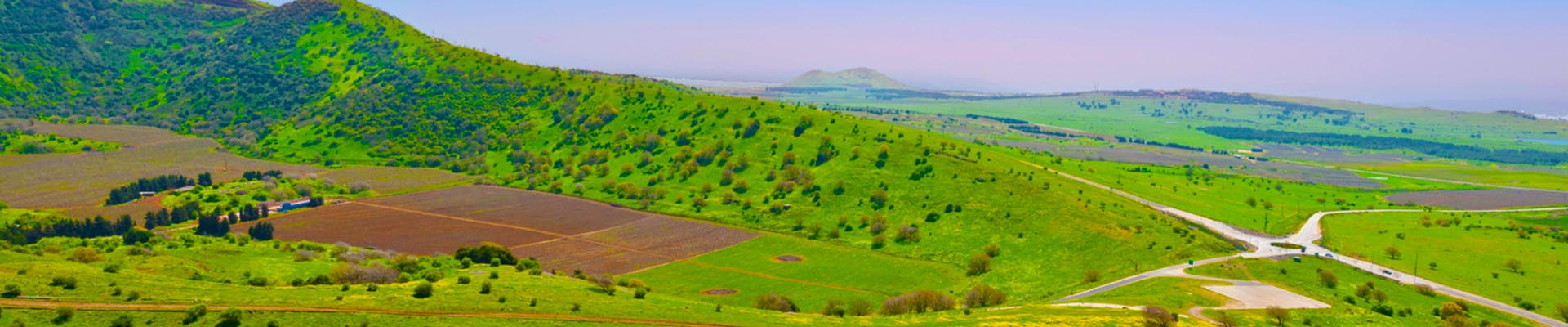
Golan Heights